
Feeling politically responsible, bout ye?
On civic-mindedness OR just that time I went looking for biscuits in Belfast with a US American accent.

Middle-aged Belfast man: “Are you American?”
This has always been a loaded question for me. I was already a mixed-culture kid by the time I was born, so being asked that never feels simple. But nowadays, it can land with the weight of geopolitics. At that moment, just chatting up my mentor-friend while browsing the biscuit aisle in a Tesco in Belfast, it felt abrupt and disorienting. Like I’d been pulled into a public reckoning of my political identity while reaching for a snack.
Me: [Frozen as I mentally sorted through all the possible ways to answer]
Thankfully, my mentor-friend, who was with me, stepped in.
Mentor-friend: “Yes, she is…sort of.”
Man: “How did you vote in that nutter? I was just down at the shipyard with the lads, talking about how those tariffs are affecting our work. And that Marjorie Taylor Greene—what another nutter!”
Me: [Still frozen]
Mentor-friend: “That’s why she left!”
Unfortunately for my mentor-friend, she had to listen to me unpack that moment for the rest of the weekend. I kept circling back to it, trying to make sense of what had happened, why I froze, and what it meant to be seen so quickly and politically in a place that wasn’t mine.
When the observer becomes observed.
Before the disruptive biscuit perusing, we’d spent the morning on the top deck of a hop-on-hop-off tourist bus. Yep, we went around twice, as we indulged in the socio-political stories of Belfast and repeated the cheeky humor our first-round tour guide had said. I always find those moments to bring up a voyeuristic tension of sorts, observing a city marked by a recent,ongoing history.
It’s the unease of watching others go about their day without truly belonging. I had thought I was simply observing Belfast—absorbing its layered identity politics and scars. I was immersed in the history of The Troubles, trying to make sense of how identities fracture communities.
But that illusion of distance the double-decker bus provided dissolved the moment I was confronted in the biscuit aisle. Suddenly, I wasn’t just observing the past, I was being observed in the present.
To be honest, I persistently thought about that middle-aged Belfast man more than I’ve thought about any man in a very long time (clearly). I imagined him at the shipyard, the Samson and Goliath H&W cranes towering in the background, a Titanic-era backdrop. I imagined the conversations he and his workmates were having that day, the feeling of uncertainty around his work, how that uncertainty was ignited by something beyond the borders of Northern Ireland on the other side of the Atlantic would affect his family, maybe kids and so on.
It didn’t matter whether I had voted for Trump or not. At that moment, I was a stand-in for a system that touched this man’s livelihood. A system that predates Trump, and yet helped pave the way for him. One that implicates me, whether I like it or not.
Instead of defending myself for being from the U.S., or saying I didn’t vote for Trump, or taking his tone as accusatory, I landed on something else:
Well, yeah. I did not vote for him, but I’m responsible too.
Thanks to him, I ended up learning more about the history of dockworker strikes and unions in the early 1900s, the working-class people of Belfast. That man offered me a lesson in civic engagement. No matter where we stand politically, we are all complicit. You can point fingers, call names, shift blame—but the truth is, the U.S., with its widening inequalities and profit-driven systems, built a culture that rewards survival through individualism, inwardness, and disconnection.
It has fractured our sense of community and responsibility, and that fracture ripples outward. It becomes foreign policy. It becomes recent steel tariffs. It becomes me, being observed, frozen in a biscuit aisle, trying to figure out who and what I represent.

Image from Getty Images at bbc.com
What is civic-mindedness?
Civic engagement runs deep and it is sometimes understood as an occasional thing we do. We often think of it as a vote here, a volunteering day there, staying updated on the news, or complaining about the decisions of the “other side.” While these are all important, they become stale if not integrated into our everyday actions.
Civic engagement is something we can learn and cultivate over time, what is known as ‘civic-mindedness’. Researchers Bringle & Steinberg, define civic-mindedness as “a person’s inclination to be knowledgeable about and involved in the community, with the commitment to act on a sense of responsibility as a member of that community.”
Civic-mindedness has three ingredients:
Our identity: The understanding of our multiple identities and how they affect our communities. For example, a US-American with Spanish citizenship bopping around town in Belfast.
Our education: The civic knowledge and skills we acquire through formal and informal experiences. For example, in a university classroom or let’s say a grocery store in Belfast.
Our civic actions: Advocacy, community service, civic organization participation, political involvement, volunteering, and voting.
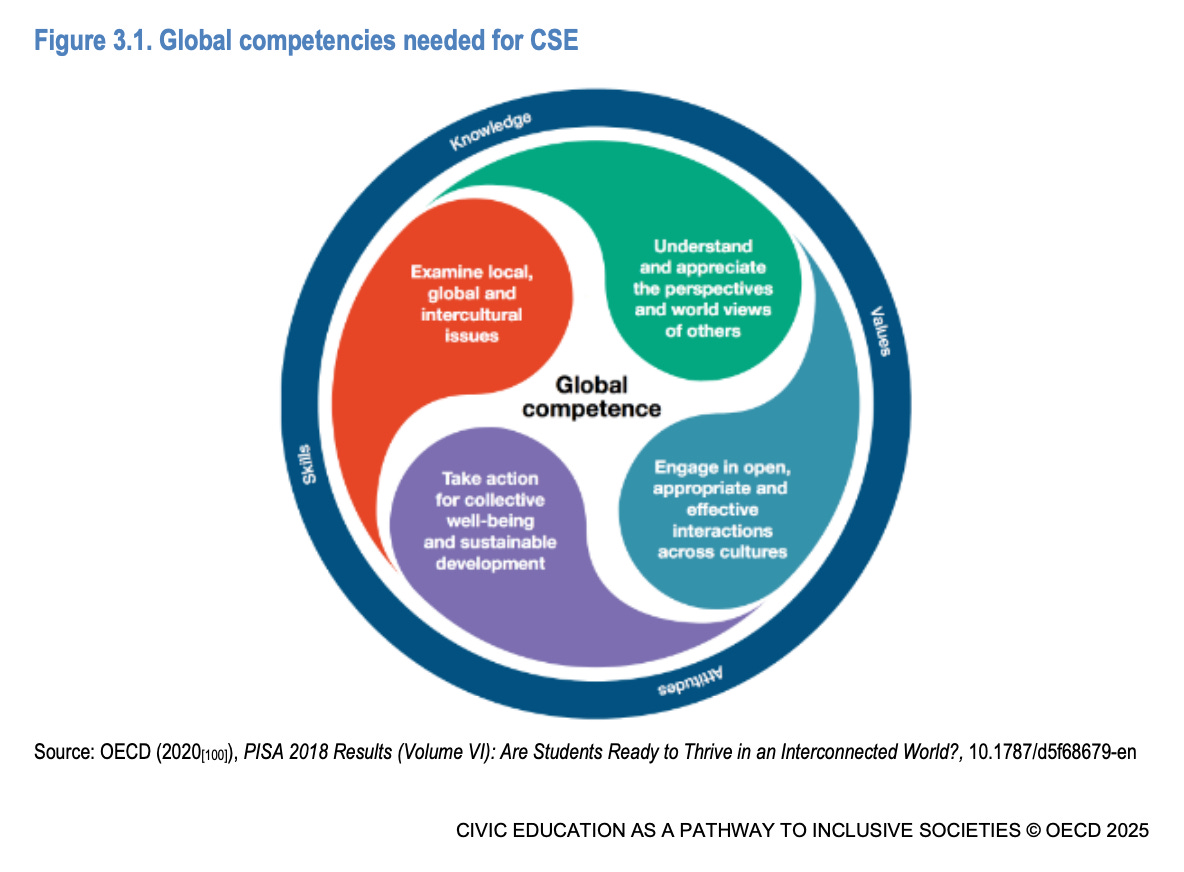
Nowadays, thanks to the impacts of globalization, digitalization and everything in between civic-mindedness, includes a global component to it. More and more, our supply chains (the people and resources that make our daily lives possible) are no longer something of our communities. Our communities are local and global.
As people who grow and live in the United States, we owe it to the rest of the world as an accrued collective debt to reconsider the competencies we have in terms of civic-mindedness. According to a recent report from the OECD, civic-mindedness is also about cultivating an awareness and understanding of the larger global systems at play. The OECD reflects the interconnectedness we must embrace to shaping more responsible societies. See image below.
But I am le tired *
*Reference to an early 2000s video“ End of Ze World “
I’ve heard this sentiment time and again: "It’s too exhausting." Some of the most insightful and politically engaged people and journalists I admire describe the emotional fatigue of the news since the pandemic. Take Jia Tolentino. She writes about how our brains, overwhelmed by the constant influx of crises and injustice, the hyper-connectivity to it all eventually breaks her brain. Liz Plank has also discussed this in her post “None of My Emails Are Finding Me Well.”
I see you. I hear you. What has happened over the last 100 and some days is the culmination of decades of injustices and erosion of democracy. However, friends, there’s a collective responsibility here that transcends individual burnout. The very essence of civic-mindedness asks us to reconsider.
We are not isolated individuals, and we need each other to engage politically.
Belfast’s motto, Pro tanto quid retribuamus—"what shall we give back in return for so much" is a direct call to action. We owe it to our neighbors near and far to act in ways that don’t just defend our interests but challenge the structures that make us complacent and disconnected. Our civic-mindedness will require an everyday type of persistence:
Sail on, sail on
O mighty ship of state!
To the shores of need
Past the reefs of greed
Through the squalls of hate
Sail on, sail on, sail on...
[Lyrics from Leonard Cohen in ‘Democracy’]